14 Aug 2026
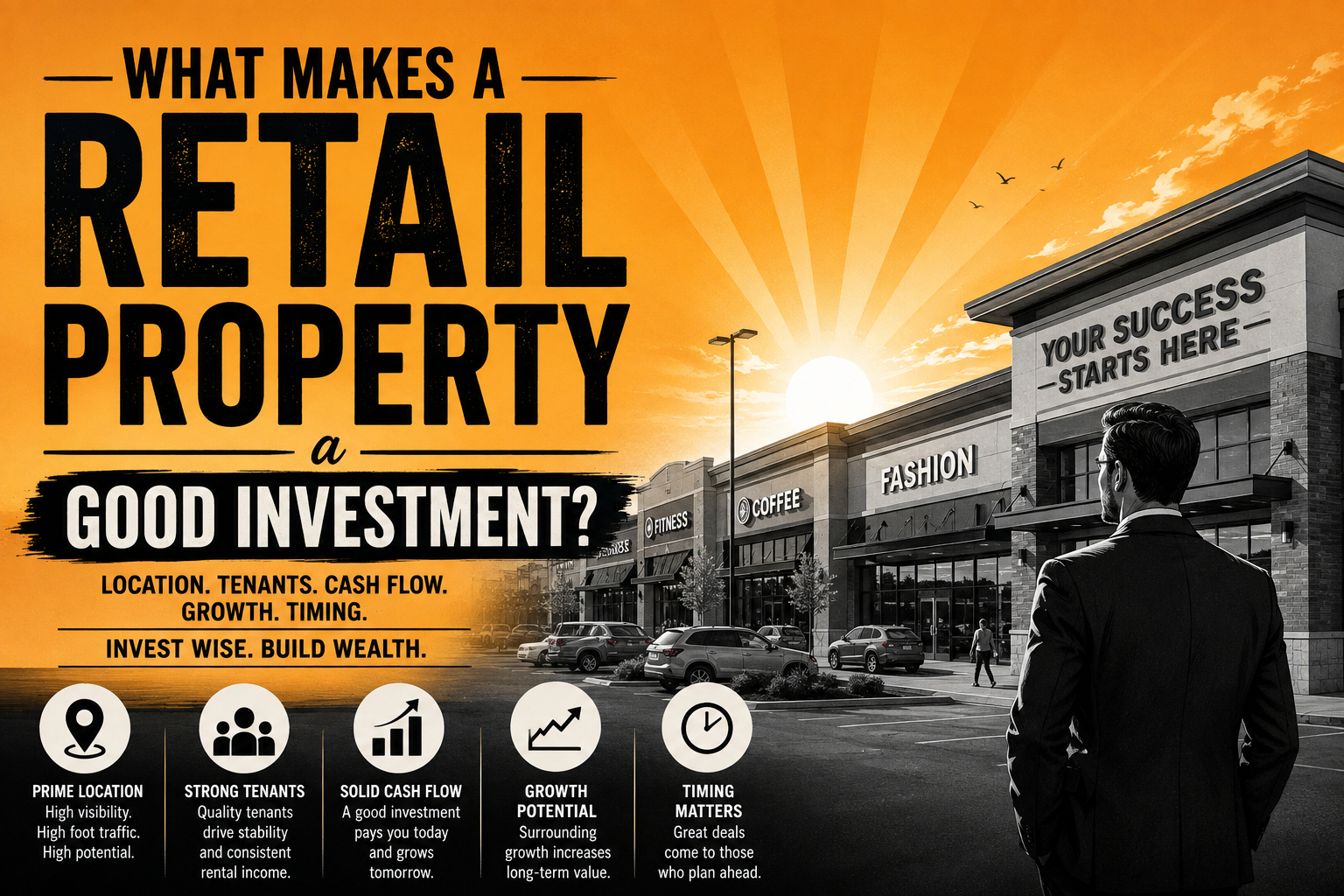
What Makes a Retail Property a Good Investment?
Retail property investment remains one of the most sought-after asset classes in South African commercial real estate — but not every retail unit or shopping centre makes a sound investment. The difference between a retail property that delivers consistent rental income and one that becomes a drain on your portfolio usually comes down to seven measurable factors. Whether you're evaluating a freestanding retail unit, a strip mall bay, or a stake in a larger shopping centre, working through these criteria systematically will tell you far more than a glossy brochure ever will.
1. Tenant Quality: The Foundation of Retail Income
Tenant quality is the single biggest driver of long-term retail property value. A property let to a national retailer, bank, or well-established franchise on a long lease carries far less risk than one let to an unproven independent trader, regardless of how attractive the rental looks on paper.
When assessing tenant quality, look beyond the name on the lease agreement:
• Covenant strength: Is the tenant a listed company, franchise, or independent trader? National and franchise tenants typically offer stronger financial backing and lower default risk.
• Trading history: How long has the tenant operated at this location, and what is their track record of paying rent on time?
• Tenant mix: Does the property or centre have a healthy blend of anchor tenants (supermarkets, pharmacies, banks) and line shops? A strong anchor tenant drives consistent footfall for everyone else.
• Trading density: Turnover per square metre is the clearest indicator of whether a tenant is genuinely viable at that location, not just occupying space.
2. Lease Terms: Where the Real Value Is Locked In
A retail property is only as good as the lease agreements underpinning it. Two properties with identical rental income can have very different investment value depending on the strength and structure of their leases.
Key lease terms to scrutinise
• Lease duration and renewal options: Longer leases (5–10 years) with formal renewal options provide income certainty and support a stronger resale valuation.
• Escalation clauses: South African retail leases typically escalate rental at 8–10% per annum. Confirm this is contractual, not assumed.
• Turnover rental clauses: Some leases include a turnover-based component in addition to base rental, aligning landlord and tenant interests but adding income variability.
• Repairs and maintenance obligations: Establish clearly who is responsible for structural repairs, HVAC, and common area maintenance — this materially affects your net return.
• Break clauses and exit rights: Early termination rights held by the tenant can undermine an otherwise attractive lease term.
3. Rental Yield: Measuring the Real Return
Rental yield remains the primary metric for comparing retail property investments, but it needs to be calculated correctly to be meaningful.
• Gross yield: Annual rental income divided by purchase price. Useful for a quick comparison, but it ignores costs.
• Net yield: Gross yield less operating costs (rates, levies, insurance, maintenance, vacancy allowance). This is the number that reflects what you actually keep.
• Cash-on-cash return: Net income relative to the actual cash invested, factoring in bond financing — critical if you're leveraging the purchase.
As a general guide, well-let retail property in South Africa's secondary metros and established nodes typically trades in the 9–12% gross yield range, with prime, nationally-tenanted centres trading tighter on yield in exchange for lower risk. Always stress-test the yield against a realistic vacancy assumption, not a best-case scenario.
4. Foot Traffic: The Engine of Retail Turnover
Foot traffic is what ultimately drives tenant turnover, which drives rental sustainability. A retail property with poor pedestrian and vehicle flow will struggle to retain tenants regardless of how attractive the lease terms look on day one.
• Anchor-driven traffic: Proximity to a supermarket, taxi rank, transport node, or major employer consistently outperforms standalone retail with no natural footfall generator.
• Catchment population and income profile: Match the tenant mix to the surrounding suburb or industrial node's population density and spending power.
• Time-of-day and day-of-week patterns: A centre that only draws traffic on weekends or month-end (pension/salary days) carries higher income volatility than one with consistent daily flow.
5. Visibility: The Silent Driver of Rental Value
Visibility from a main road, taxi route, or high-traffic intersection has a direct and measurable effect on achievable rental — often more than tenants themselves will admit during negotiation. Corner positions, street-facing frontage, and clear signage rights consistently command a rental premium over units set back from the road or hidden behind other buildings.
• Confirm signage rights are included in the lease and check for any body corporate or municipal restrictions on signage.
• Assess sightlines from the nearest major road or intersection, not just the property boundary.
• Consider night-time visibility — lighting and illuminated signage matter for extended-hours retail and restaurants.
6. Parking: Often Underestimated, Rarely Optional
Parking ratio is one of the most under-analysed factors in retail property investment, yet it's frequently the reason a well-located centre underperforms. Insufficient parking caps trading potential regardless of how strong the tenant mix or visibility is
• Benchmark parking ratio against similar retail formats — convenience centres typically need higher bays-per-100m² of GLA than destination or bulk retail.
• Check for shared parking arrangements with neighbouring properties, which can understate true available parking during peak trading.
Consider security and covered parking as a differentiator in competitive nodes — increasingly a tenant and customer expectation rather than a nice-to-have.
7. Future Development Potential
The best retail property investments often carry optionality beyond current rental income. Before buying, consider what the property — and the land around it — could become.
• Zoning and bulk: Confirm current zoning rights and any unused bulk that could support future extensions, additional bays, or mixed-use redevelopment.
• Surrounding infrastructure and development pipeline: New roads, residential developments, or transport nodes nearby can materially uplift both rental and capital value over a 5–10 year hold.
• Redevelopment or repositioning potential: Could underperforming space be reconfigured for a stronger tenant mix, drive-through format, or additional density if demand shifts?
This is where working with a broker who understands the local development pipeline — not just current listings — pays for itself. On the East Rand specifically, industrial-to-retail conversion and infill development around established nodes like Germiston, Boksburg and Benoni continue to create opportunities that aren't always obvious from a standard property listing.
Frequently Asked Questions
What is a good rental yield for retail property in South Africa?
Gross yields of 9–12% are typical for well-let secondary retail, while prime, nationally-tenanted centres often trade at lower yields in exchange for reduced risk. Always calculate net yield after operating costs before comparing properties.
How important is tenant mix compared to rental income?
Tenant mix is arguably more important than the current rental figure. A property with a strong anchor tenant and balanced line-shop mix will protect and grow rental income over time, while a property overly reliant on a single vulnerable tenant carries concentration risk.
Does parking really affect retail property value?
Yes — insufficient parking is one of the most common reasons a well-located retail property underperforms its potential, as it directly caps customer volume and tenant trading density.
What lease term should I look for when buying a tenanted retail property?
Leases of five years or longer with formal renewal options and contractual escalation clauses provide the strongest income certainty and typically support a better resale valuation.
The Bottom Line
A good retail property investment is rarely about one standout feature — it's the combination of a resilient tenant, a well-structured lease, a realistic net yield, genuine foot traffic, strong visibility, adequate parking, and room to grow. Evaluate every retail opportunity against all seven factors, not just the ones that happen to look best in the listing, and you'll make sharper investment decisions
Considering a retail property investment on the East Rand? Fox & Co Realty can help you evaluate tenant quality, lease structure and yield before you commit. Get in touch to discuss current opportunities in Germiston, Boksburg, Edenvale, Wadeville, Benoni and Springs.
