18 Aug 2026
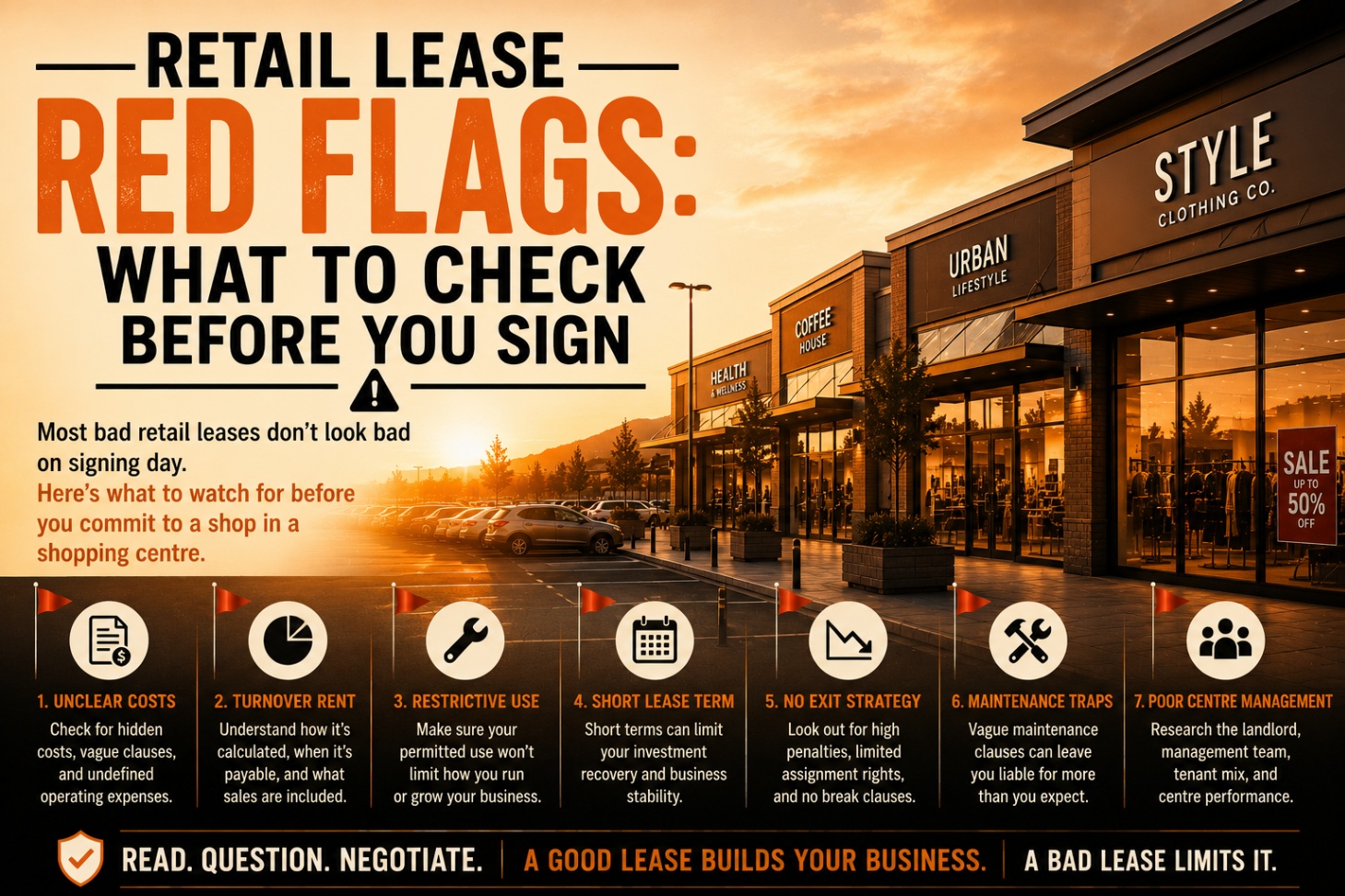
Retail Lease Red Flags: What to Check Before You Sign: Most bad retail leases don't look bad on signing day. Here's what to watch for before you commit to a shop in a shopping centre.
1. A Rental Based on GLA With No NLA Disclosed
If a lease quotes rental purely on Gross Lettable Area (GLA) and the landlord can't or won't tell you the Net Lettable Area (NLA), treat that as a red flag rather than an oversight. A wide gap between the two means you're paying full rental on space you can't actually use for stock, staff, or customers. Ask for both figures in writing before you compare this property to any other option.
2. Vague or Undisclosed Operating Costs
Base rental is only part of what you'll pay each month. Operating costs — your share of cleaning, security, common area electricity, and centre marketing — can add a substantial amount on top, and in a poorly run centre, they can escalate far faster than the base rental itself. If a landlord is reluctant to share a levy history for the past two to three years, or the operating cost estimate feels suspiciously round and unsubstantiated, ask why. A landlord confident in their cost management will usually share this without hesitation.
3. No Co-Tenancy Protection
If your shop's foot traffic depends heavily on a specific anchor tenant — a supermarket, pharmacy, or major retailer — and the lease has no co-tenancy clause, you're carrying risk the landlord isn't sharing. Without this protection, if that anchor tenant leaves, you're still on the hook for full rental even as your own trading collapses. This is one of the most overlooked red flags in retail leasing, precisely because it only becomes a problem after the anchor is already gone.
4. An Escalation Rate That's Open to Negotiation Later
Most South African retail leases escalate rental by 8–10% annually, and that's normal. What's not normal — and worth questioning — is a lease where the escalation rate is described as "to be agreed" or reviewable at the landlord's discretion rather than fixed as a contractual percentage. An open-ended escalation clause hands the landlord leverage every single year of your lease.
5. No Mention of Signage Rights
Verbal promises about shopfront signage, directory listings, or illuminated branding mean nothing once the lease is signed. If signage rights aren't explicitly documented — including size, position, and any centre restrictions — you may find yourself negotiating for visibility you assumed was already part of the deal. This matters more than most first-time tenants expect, since visibility is often the difference between a shop that gets discovered and one that doesn't.
6. Restrictive Trading Hours With No Flexibility
Centre management setting minimum trading hours is standard and reasonable. What's worth flagging is a lease with rigid, non-negotiable hours that don't suit your business model — a restaurant wanting to trade later, for example, or a specialist retailer with a naturally different customer flow. Check this clause against how you actually intend to operate, not just how the centre currently operates.
7. A Landlord Who Can't Produce Trading Density Figures
If you're taking on a unit in an established centre, ask for trading density figures — turnover per square metre — for comparable tenants, or at minimum the centre's overall performance trends. A landlord or leasing agent who can't or won't produce any performance data is either not tracking it, which is itself concerning, or reluctant to show numbers that don't support the deal they're pitching.
8. Onerous Repairs and Maintenance Obligations
Check exactly who is responsible for what. Some leases quietly shift structural repairs, HVAC maintenance, or shopfront upkeep entirely onto the tenant — costs that can run into tens of thousands of rands and were never priced into your original budgeting. This clause deserves the same scrutiny as the rental figure itself.
9. Weak or One-Sided Breach and Cancellation Terms
Every lease needs a breach clause, but read closely for balance. A lease that gives the landlord broad discretion to cancel for minor infractions, while offering the tenant no equivalent recourse if the landlord fails to maintain the centre or deliver agreed services, is structurally tilted against you before you've even opened your doors.
10. Pressure to Sign Quickly Without Time to Review
This isn't a clause — it's a pattern. If you're being pushed to sign before you've had a chance to have the lease reviewed, or told that a TI allowance or favourable rental is only available if you sign "today," slow down. A legitimate opportunity will still be there after you've had proper time to review the terms; pressure tactics are themselves worth treating as a red flag.
The Bottom Line
None of these red flags are necessarily deal-breakers on their own — but each one is a signal to ask more questions before you sign, not after. The tenants who avoid the costliest retail lease mistakes aren't the ones who got lucky; they're the ones who took the time to check GLA against NLA, ask for a levy history, request co-tenancy protection, and get every verbal promise put in writing. A good lease should hold up just as well in year three as it did on the day you signed it.
Frequently Asked Questions
What is the biggest red flag in a retail lease?
An escalation clause left open to future negotiation rather than fixed at a set percentage is one of the most consistently costly red flags, since it removes the certainty a tenant needs to plan rental costs over the full lease term.
Should I get a retail lease reviewed before signing?
Yes. A short legal or broker review before signing is inexpensive relative to the cost of discovering a problematic clause after you've already committed to fit-out costs and opened for trade.
What should I ask a landlord before renting a retail shop?
Request the NLA alongside the GLA, a levy history for the past two to three years, current trading density figures for the centre, and written confirmation of any signage rights or tenant installation allowance discussed verbally.
Is a high tenant installation allowance always a good sign?
Not necessarily. A generous TI allowance can sometimes offset a weaker underlying lease structure elsewhere, such as a higher escalation rate or absent co-tenancy protection. Evaluate the lease as a whole rather than any single incentive in isolation.
